
TELUS Rewards
TELUS Rewards was a high-performing national loyalty program with a growing catalogue of physical rewards, digital gift cards, contests, and exclusive member perks.
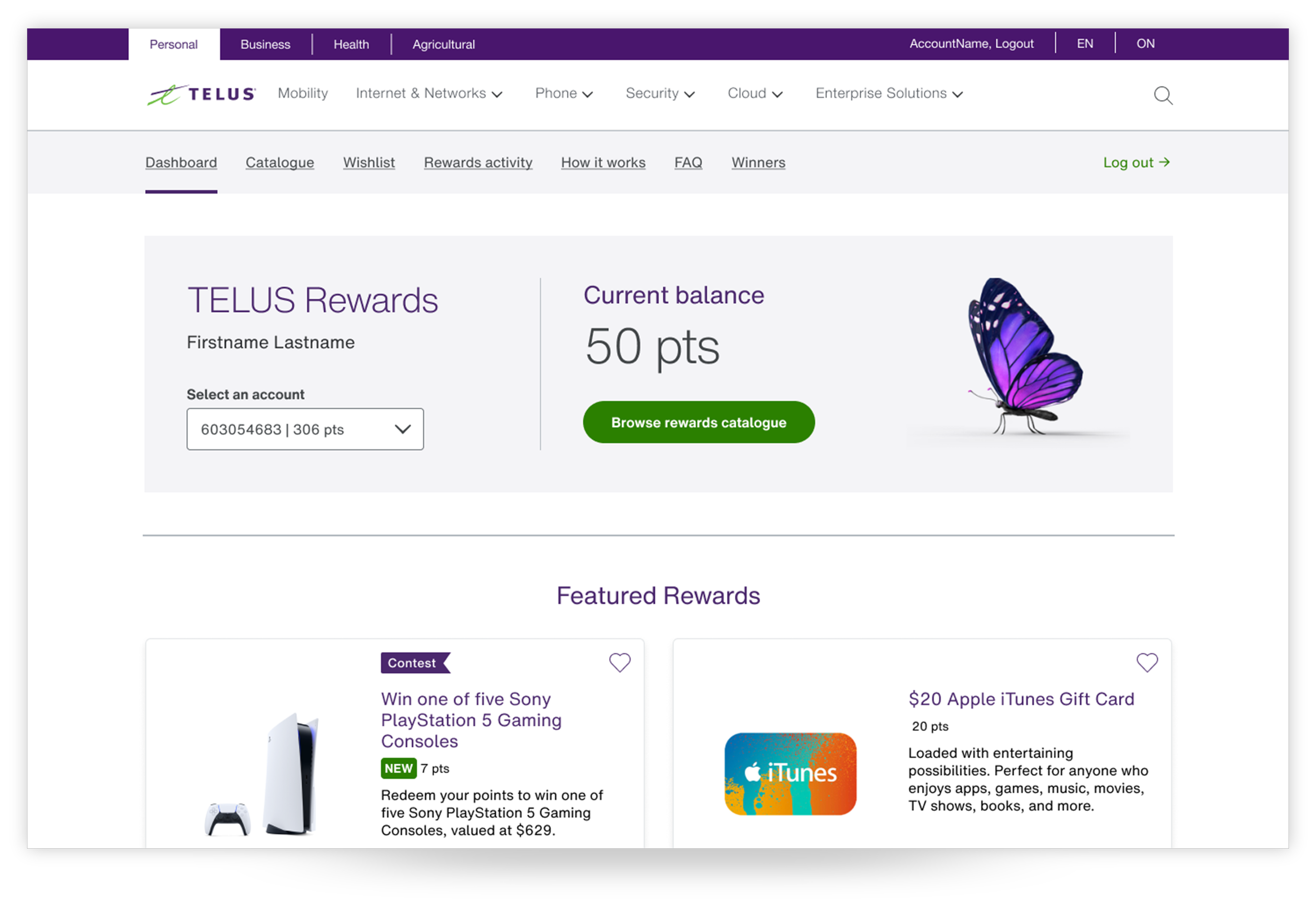
The TELUS Rewards program was seeing great commercial success. This however created a new challenge. The platform had evolved beyond the limits of its original design framework, making it increasingly difficult to scale new reward types, support promotional complexity, and respond to a growing backlog of customer and business needs.
The opportunity was not simply to refresh the interface, but to re-architect the experience so the program could continue to grow without losing clarity, flexibility, or operational efficiency.
KEY SUCCESSES
30%
70%
Increase in Wishlist page engagement.
ROLE I PLAYED
Increase in overall portal traffic.
AGENCY
Architech
CLIENT
TELUS
Design strategy for the member portal
Member experience and redemption flow design
UI modernization aligned to TELUS Design System
Multi-stakeholder alignment across TELUS Digital, Rewards, and Architech
Research and design pod scaling
UX maturity and practice alignment
Vendor and standards alignment
Executive and cross-functional communication
The challenge
TELUS Digital already had very mature design and delivery practices in place, and the Rewards program was expected to meet those same standards. The challenge was to bring the Rewards member portal into line with enterprise expectations while supporting an increase in members, products, and product types, and a more complex redemption model.
At the same time, loyalty operations were heavily developer‑dependent: marketing teams relied on development requests for catalogue updates, promotions, and partner integrations, which slowed response to market conditions and competitive moves. Platform stability during high‑traffic redemption periods was also a concern, and partner collaboration workflows required manual technical coordination. The design work needed to support a shift toward more team‑driven operations without breaking the experience customers already knew.
Update the member portal experience to accommodate growth in members, products, and product types.
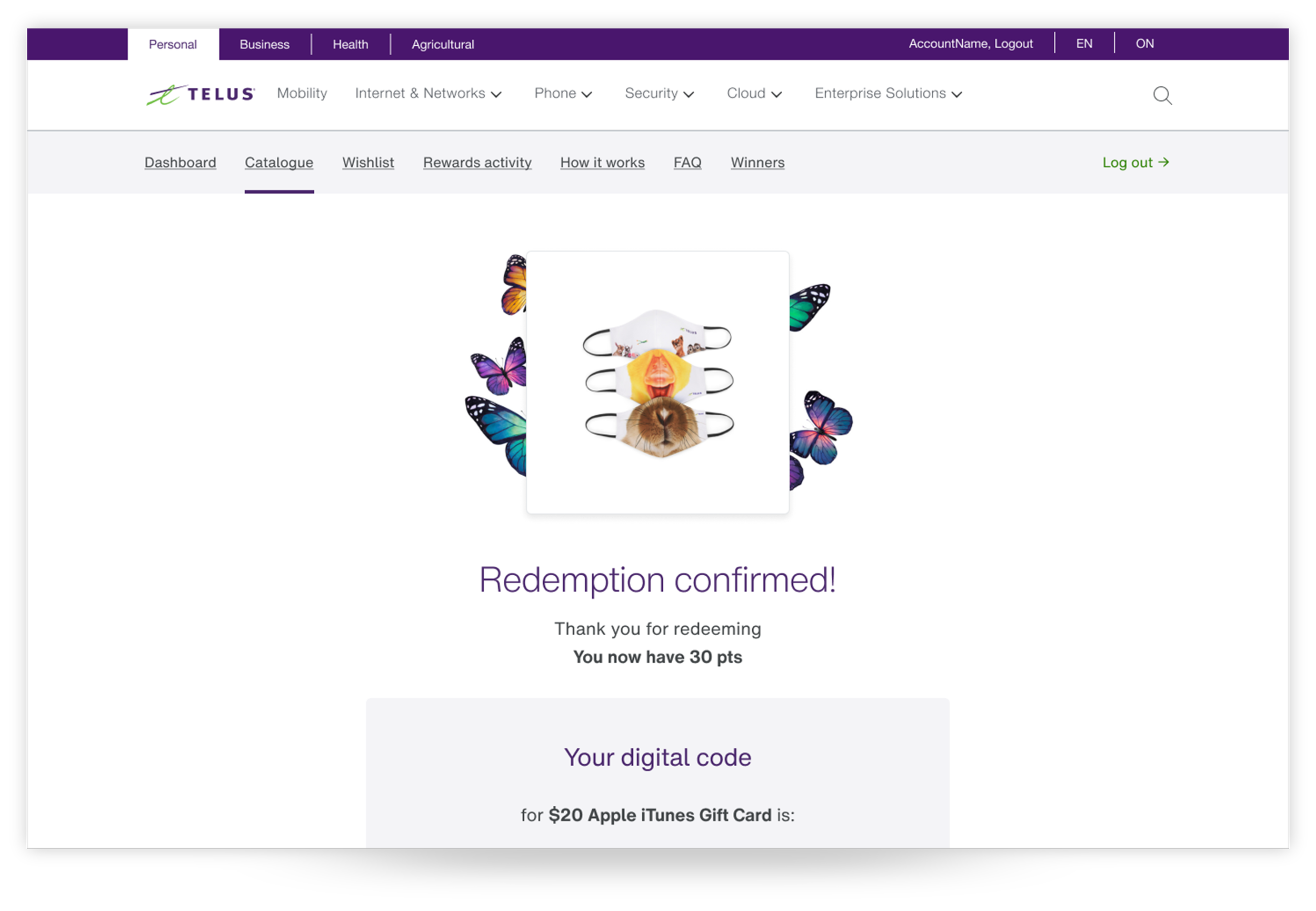
Design a new, clearer redemption flow that could scale with more offers and partners.
Modernize the UI and align it to TELUS’s design system for a more cohesive experience across digital properties.
Ensure the Rewards experience met TELUS Digital’s standards for accessibility, consistency, and quality.
Align multiple stakeholders across TELUS Digital, Rewards, and Architech around a shared design direction and operating model.
What needed to happen:
The solution
As Design Lead, I led the design strategy and helped design the final product across many parts of the member portal, with a focus on the experiences that would most directly affect member behaviour and operational flexibility. That included updating the overall experience to accommodate an increase in members, products, and product types, designing the new redemption flow, and moving the UI toward a more modern, TELUS‑aligned design system.
A major part of the work was multi-stakeholder alignment. TELUS Digital’s standards were high, and the Rewards team needed to operate at that same level to avoid creating another siloed, inconsistent experience. I worked closely with TELUS Digital, Their Design System Team and the Rewards product team to ensure that design decisions supported both the member experience and the broader enterprise ecosystem, from accessibility and component usage to content patterns and interaction standards.
Alongside the member-facing work, the program shifted loyalty operations from developer-dependent to team-driven. The redesigned operations model separated marketing decisions from technical execution, enabling marketing teams to independently manage catalogues, orders, and promotions without filing development requests for every change.
To support this, I scaled a design pod for TELUS Rewards, bringing in research and design support. This helped raise the UX maturity of the Rewards stream and ensured that Architech’s design practices benefited the broader organization through osmosis, rather than working around or against existing TELUS standards.

Creating a flexible product system
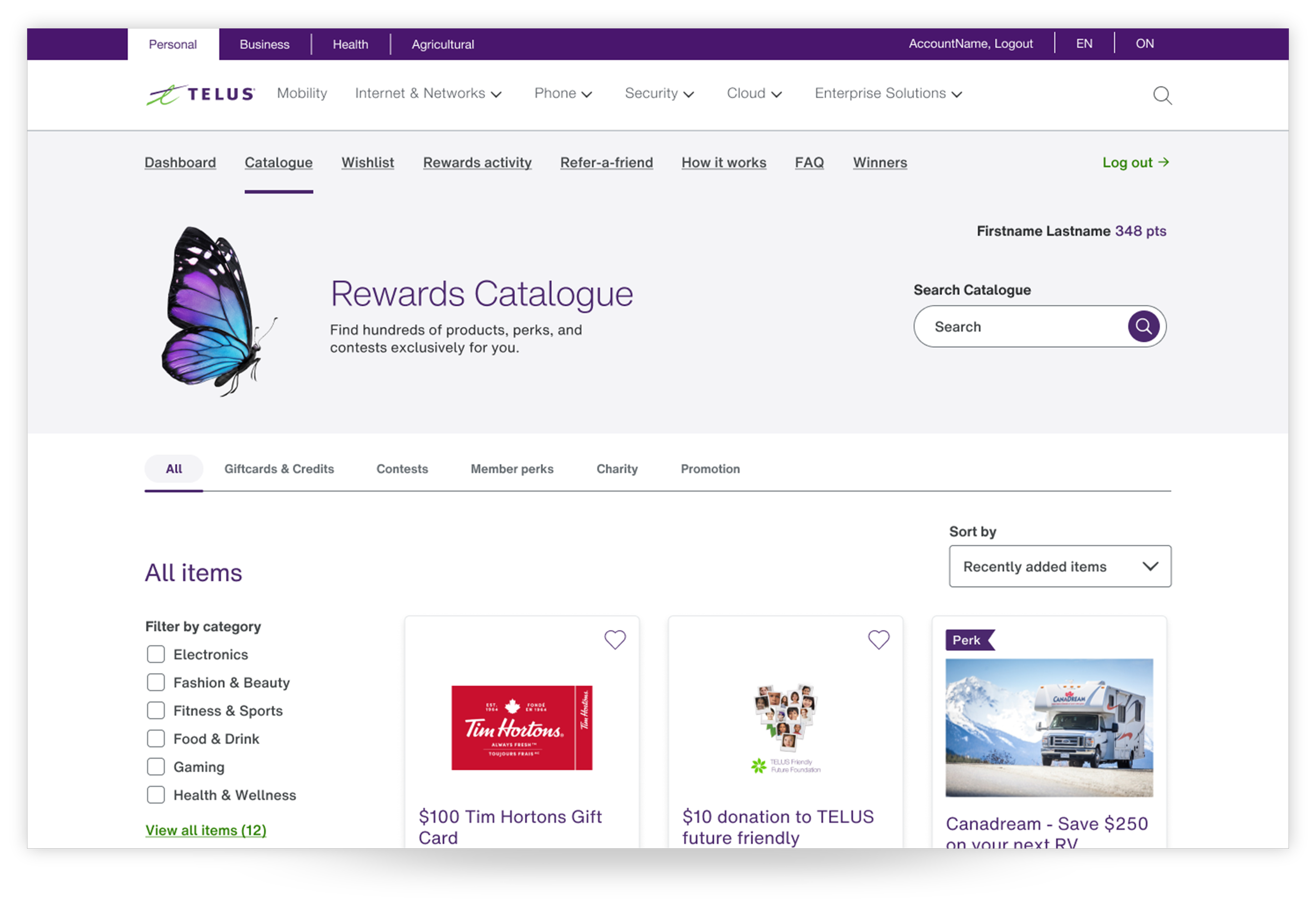
A major part of the redesign centred on the catalogue and product card model. The platform needed to accommodate an unusually wide range of product types and statuses, including digital codes, physical shipments, contests, limited inventory, promotional flags, wishlisting, and a variety of calls to action. Instead of treating these as one-off design exceptions, the work established a systemized approach that could support hundreds of permutations across both page and card levels.
This was especially important because the product card had become one of the most strategically important components in the platform. It had to communicate value, availability, urgency, and next steps at a glance while remaining flexible enough to support changing merchandising and operational needs. Designing that system was not just a visual exercise; it was a structural solution to product complexity.
Leadership impact
For TELUS, the work helped transform the Rewards member portal into a more scalable, modern experience that could grow with the program while meeting enterprise design and accessibility standards. The shift toward team-driven operations meant marketing could respond to market conditions and competitive moves much faster, without waiting on development cycles for routine changes.[architech]
For Architech, the engagement demonstrated the ability to plug into a mature digital organization, align with high enterprise standards, and raise UX maturity through practice and pod scaling rather than one-off deliverables. The design and workflow changes contributed to measurable improvements in engagement and stability, and helped position Architech as a partner capable of working at TELUS Digital’s level while improving how design and operations fit together.
“You are one of the best teams I have ever worked with, and I’ve worked with a lot of vendors.
It’s incredible to see the progress made on the program over the years.”
— Client for TELUS Rewards