
Agent Assist
Proactive, agentic workflows that lower handling time for customer support agents.
CLIENT
Rogers
AGENCY
Architech
Agent Assist is an internal Rogers AI assistant for customer service agents designed to lower Average Handling Time (AHT) and improve agent satisfaction. Providing them proactive, timely context as a call begins and continues.
It brings together information from multiple sources, including account details, prior interactions, transfer context, network health, order activity, and other signals. With Agent Assist agents can respond faster without switching across systems. For customers, that means less repetition and a smoother handoff experience. For the business, it means a more efficient support operation with clear cost implications.
KEY SUCCESSES
28 sec.
Approx. savings in Average Handling Time (AHT)
AA / Partial containment program in year value.
$4.1M
Product direction
Roadmap shaping
Cross-functional stakeholder alignment
Workflow and interaction strategy
Agentic experience design
ROLE I PLAYED
Design system and pattern definition
Prototyping and validation with Figma Make
Team capability and resourcing
Executive communication and positioning
The challenge
Reframe Agent Assist around real agent behaviour instead of the constraints of Genesys.
Create a standalone, flexible shell that could stay visible across the desktop and coexist with other critical tools.
Design interaction patterns that were noticeable but not disruptive during live calls, including draggable window behaviour, a minimized “listening mode,” subtle motion, and silent triggered notifications.
Incorporate related features to further reduce reliance on Genesys and normalize the Standalone App as part of the core workflow.
Extend the platform through modular features like Residential Diagnostics and Order Status, while aligning on shared language, status signals, and colour usage across tools.
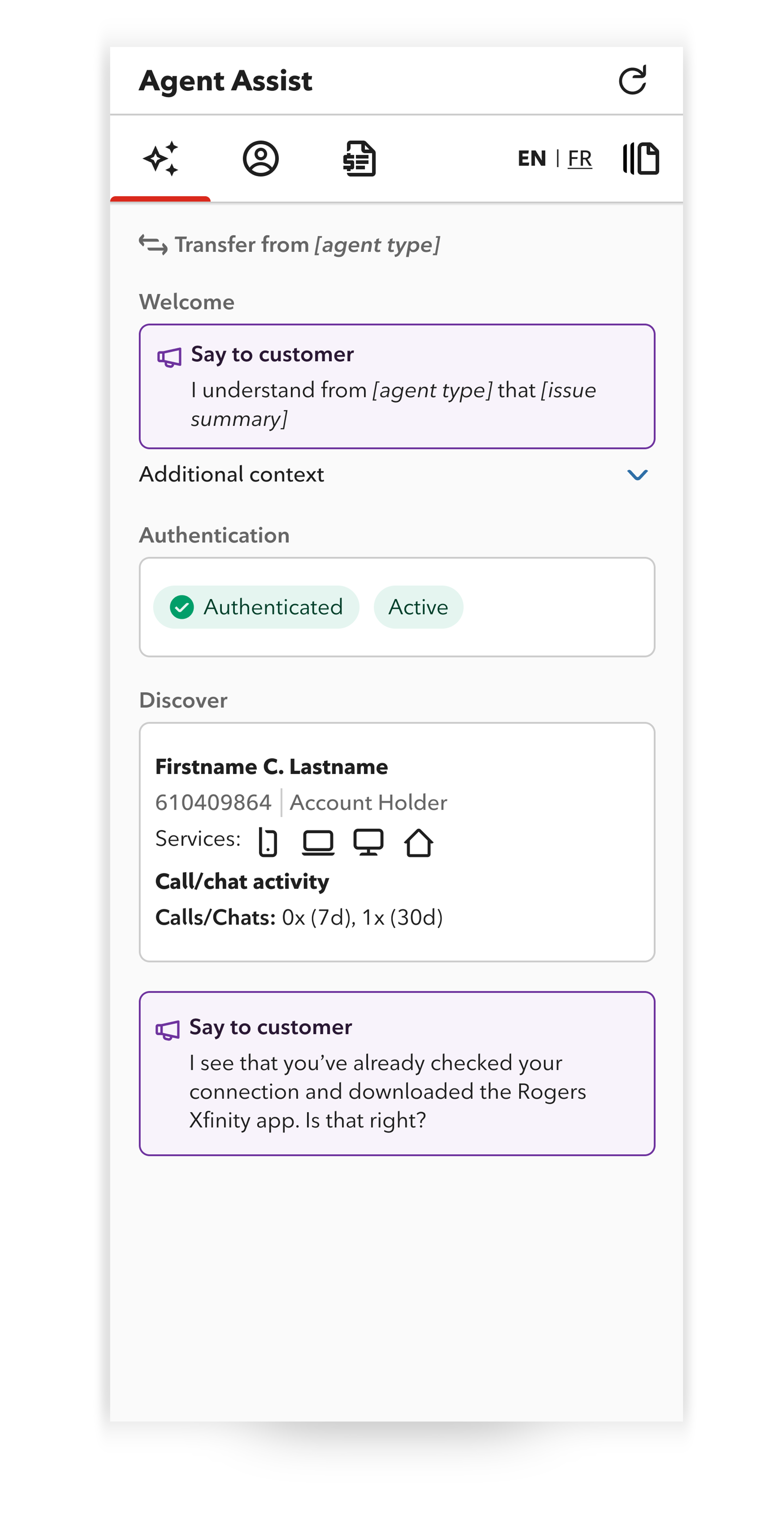
Agent Assist was originally embedded inside Genesys, the call-handling platform, but analytics showed low usage and call-listening sessions revealed why: once a call connected, agents often left Genesys and worked elsewhere until the call ended. That meant they were missing the very insights Agent Assist was designed to provide, weakening both adoption and operational efficiency.
The experience needed to fit naturally into how agents actually worked, remain visible without becoming disruptive, and earn trust as an AI-assisted recommendation tool inside a complex internal ecosystem. It also needed to align with broader goals around consistency across agent tools, long-term workflow evolution, and a scalable platform for future agentic features.
What needed to happen:
The solution
One of the most important shifts was moving Agent Assist out of Genesys and into a Standalone App that could remain visible across the desktop. That concept was selected and developed into a new shell for the same underlying product, allowing agents to stay in their natural workflow while still receiving proactive support. The standalone app helped move Agent Assist toward a more flexible platform for future integrations and modules.
The standalone product had to remain useful without becoming disruptive. Screen real estate was limited, the window had to coexist with other critical features, and proactive notifications needed to be noticeable without overwhelming agents during live calls. This led to the design of several new interaction patterns, including draggable window behaviour, a minimized “listening mode,” subtle motion to reassure agents the tool was still active, and silent triggered notifications that could surface new insights without relying on audio.
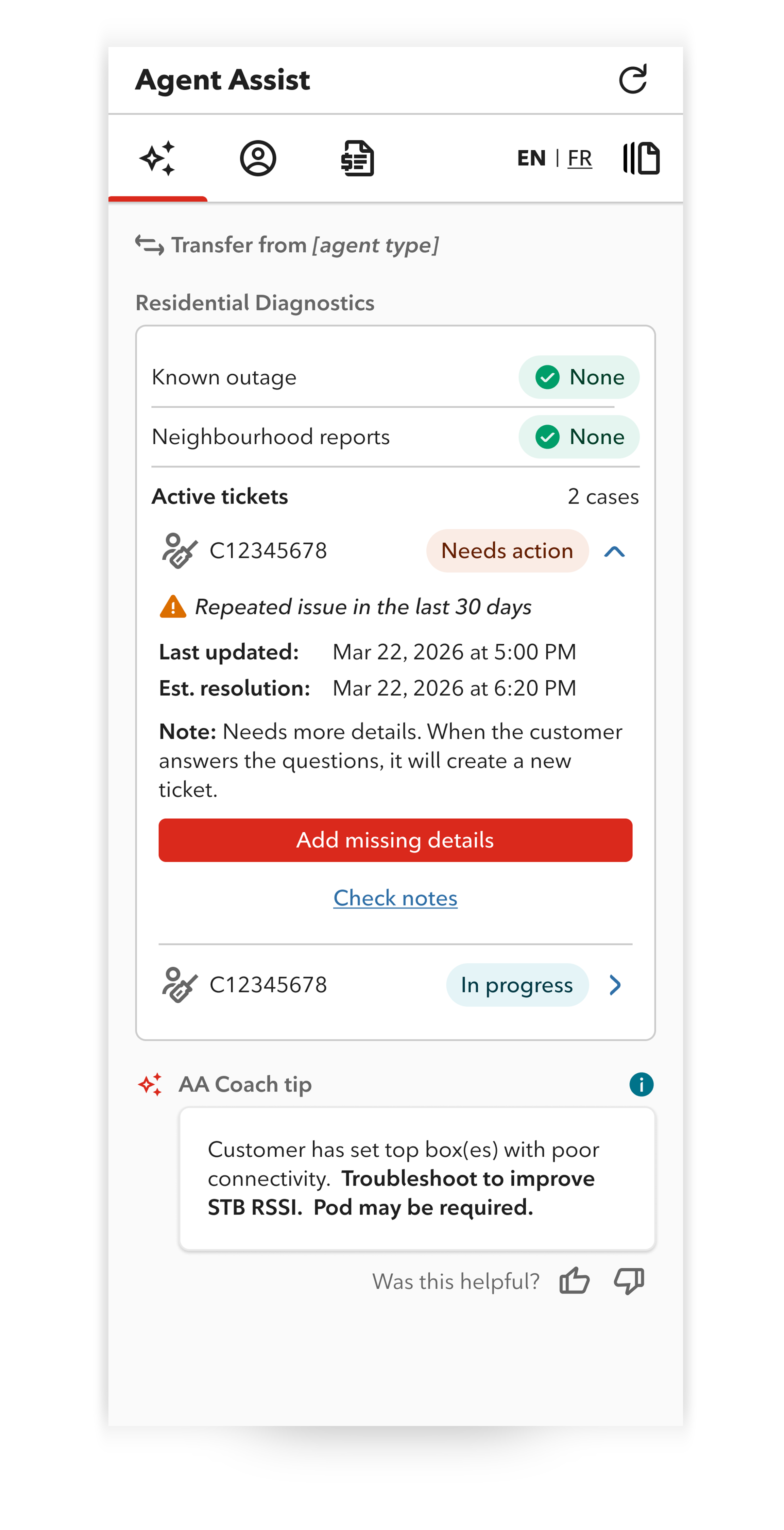
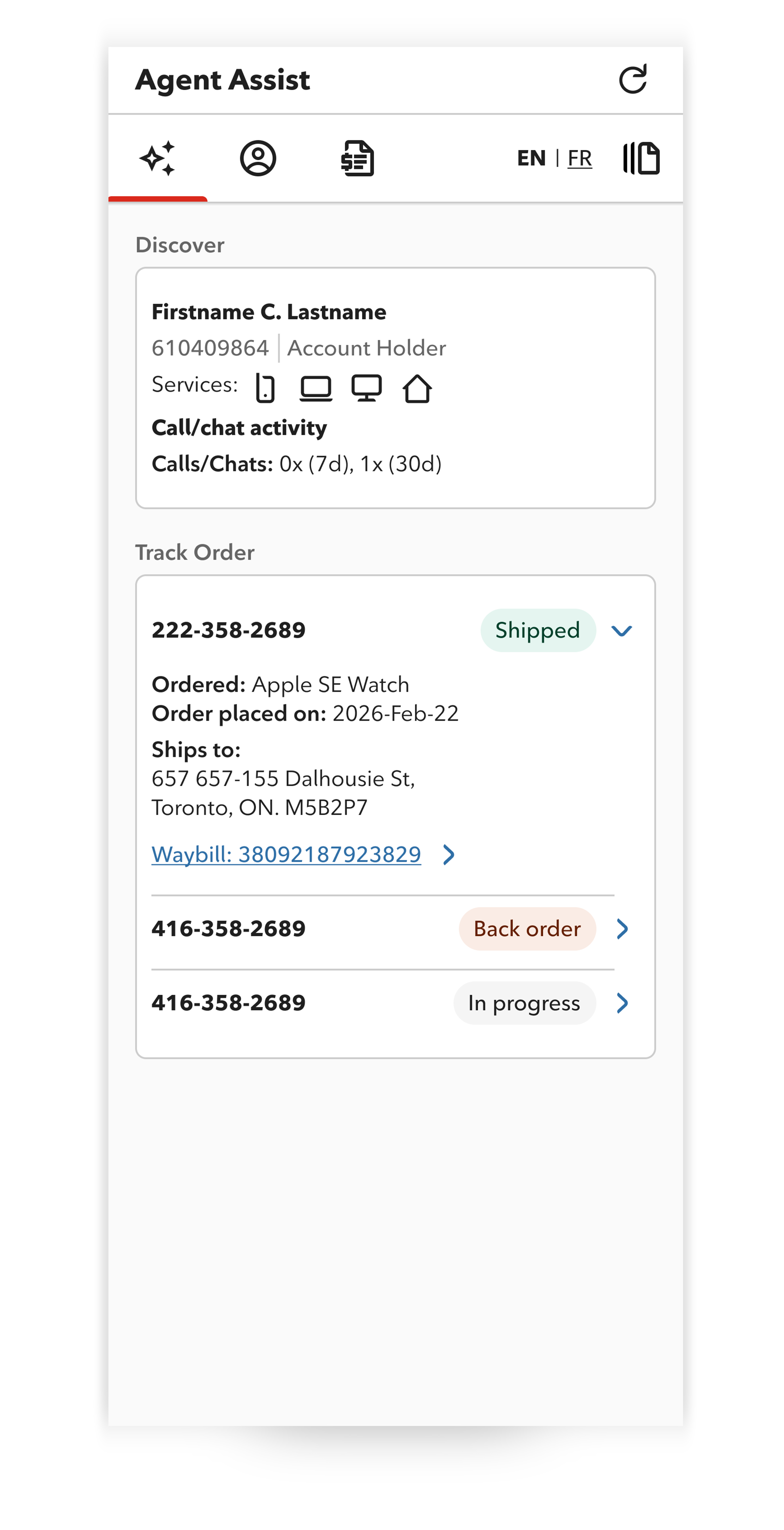
From there, the platform was extended through modular features. Residential Diagnostics had to accommodate different realities, including known outages, nearby outage reports, in-home modem and extender signal strength, and more complex residential product sets such as modems, IoT devices, and cameras. Order Status was designed to surface active orders immediately when relevant, giving agents a probabilistic signal for why the customer might be calling. That work also required cross-team alignment on status language and colour usage so agents would see the same story across tools, and the shared taxonomy created here was later adopted more broadly.
Enhancing the agent workflow even more.
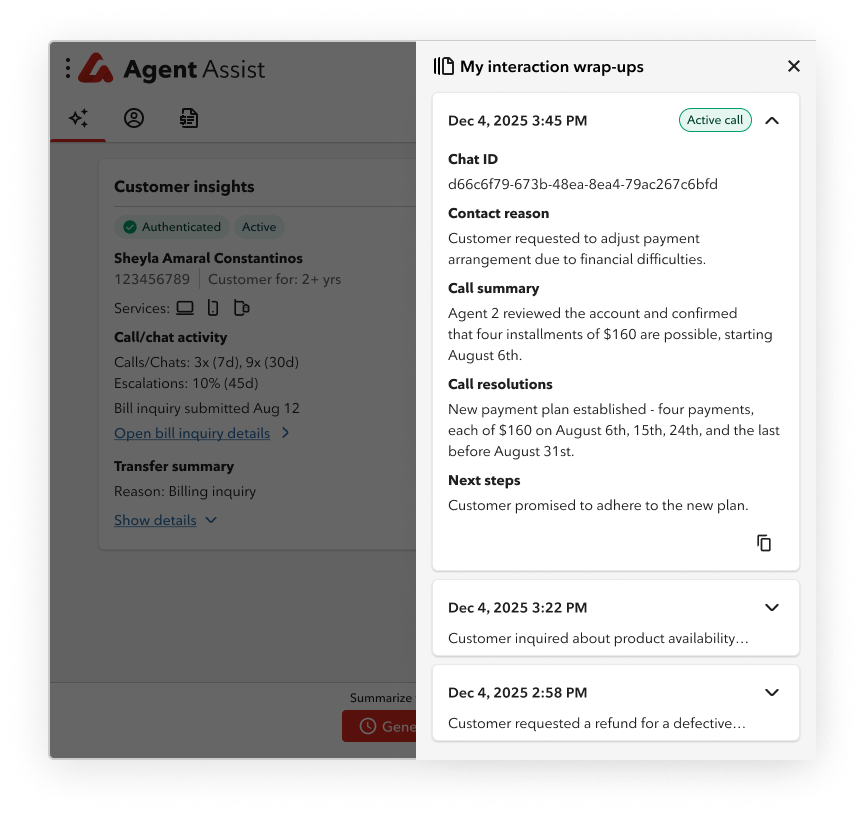
The standalone move also created a stronger foundation for expanding the product. Interaction Wrap-ups, previously a separate module, were incorporated into the standalone environment to give agents quick access to summaries of recent calls and notes that could inform the current interaction. This reduced reliance on Genesys and helped normalize the standalone tool as a central part of the workflow.
Leadership impact
For Rogers, Agent Assist became a world-class example of how proactive, agentic workflows can support live agent operations without adding friction. The experience earned strong executive support, created a clearer path for future modules, and established a more strategic foundation for how proactive assistance can be delivered inside Rogers’ support ecosystem.
For Architech, the engagement reinforced the agency’s ability to lead complex, AI-enabled service transformations at scale. The work spanned product direction, workflow strategy, interaction design, and cross-functional alignment across customer support, operations, engineering, content, design systems, the virtual assistant team, the main customer support tool, and the knowledge platform team. By scaling the design pod and introducing higher-maturity UX practices, the engagement helped position Architech as a partner capable of shaping not just features, but the operating model behind modern agent experiences.
“Agent Assist is world class”
— SVP Digital at Rogers Digital